
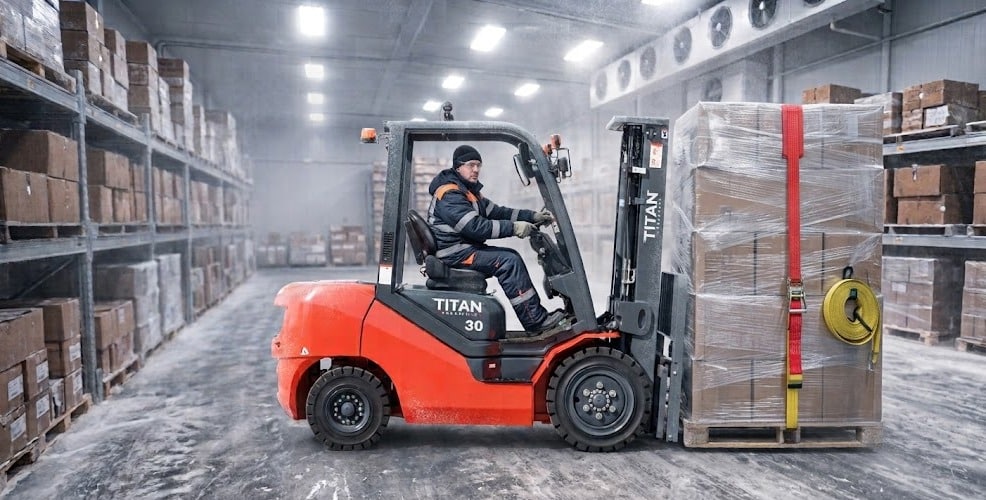
A forklift may be rated for a particular lifting capacity, travel speed, and operating cycle. However, those specifications are usually based on defined operating conditions. Exposure to very low or high temperatures can affect a forklift’s battery, hydraulic system, drivetrain, tires, electronics, and other components. As a result, businesses need specialized forklifts to meet operational needs in cold storage facilities, freezer warehouses, refrigerated distribution centers, etc. This blog will further discuss the effects of cold temperature on forklift performance.
Why do forklift batteries drain faster in cold temperatures?
One of the significant effects of cold temperature on forklift performance is the faster drainage of batteries. A forklift may require charging sooner if it spends significant time inside a freezer. Low temperatures slow the electrochemical reactions that allow a battery to deliver electrical energy. To put it simply, despite the battery still containing energy, cold temperatures can make it challenging for the battery to deliver that energy at the same rate. It may lead to the forklifts consuming their available charge faster.
The following are the effects of cold temperatures on forklift battery and overall performance.
- Reduced available capacity – A cold battery generally cannot deliver the same usable capacity as it can at a more favorable temperature.
- Higher internal resistance – Low temperatures increase the battery’s internal resistance, reducing its ability to deliver current efficiently.
- Voltage drop under load – When the forklift accelerates, lifts a heavy load, etc., battery voltage may drop more noticeably.
- Longer charging requirements – Batteries operating outside their preferred temperature range may require additional time or specific charging procedures.
- Shorter operating periods – Reduced usable capacity ultimately means fewer operating hours between charges.
Frequent transition between freezer and ambient areas
A forklift may spend part of a shift inside a freezer and then move into a warmer loading or staging area. These repeated transitions between different temperatures can affect the battery and create condensation. A very cold forklift entering a warm, humid environment may develop moisture on metal and electrical surfaces. In such conditions, maintenance teams need to follow the manufacturer’s recommendations for temperature acclimation and inspection.
Battery age and condition matter
An older or poorly maintained forklift battery may already have reduced capacity. When that battery is exposed to very low temperatures, the loss of available performance can become much more noticeable. Battery age, state of charge, maintenance history, workload, charging practices, and overall condition can affect its performance.
Effects of cold temperature on forklift performance
The following are the effects of cold temperature on forklift performance. Let’s discuss further.
Reduced battery capacity
Temperature has a direct effect on battery performance, particularly in electric forklifts. In cold environments, the chemical reactions inside a battery slow down. It can reduce the amount of energy available for powering the forklift. Operators may notice shorter run times, faster battery discharge, and reduced power when the forklift is working under heavy loads.
Voltage drop under heavy loads
Forklifts require substantial power during lifting and acceleration. Under these conditions, a cold battery may experience a greater voltage drop because of increased internal resistance. It can lead to reduced lifting or travel performance, even though the battery may still show a reasonable state of charge. For high-utilization fleets, it can lead to shorter productive operating periods and more frequent charging interruptions.
Hydraulic performance
Temperature also affects the hydraulic system of a forklift. When temperatures drop, hydraulic oil becomes thicker and flows less easily through the system. This increased viscosity can lead to
- Slower lifting
- Slower lowering
- Slower mast tilting
- Less responsive hydraulic functions
- Increased resistance within the hydraulic system
For forklifts operating in extreme temperatures, using hydraulic fluids and lubricants recommended for the expected temperature range can help maintain more consistent performance.
Reduced motor performance
Cold conditions can reduce the amount of power available from the battery. Even if the motor itself is functioning correctly, a battery that cannot deliver sufficient current may lead to slower acceleration and reduced performance.
Extreme temperatures can also affect forklift controllers and other drivetrain electronics. Modern electric forklifts rely on coordinated operation between the battery, controller, motor, sensors, and other electronic systems. A limitation in one part of the system can therefore affect overall vehicle performance. Therefore, a forklift that doesn’t perform well in a freezer should not automatically be assumed to have a failing motor. Battery temperature and overall system conditions should also be investigated.
Lubricant viscosity
Lubricants are designed to reduce friction and protect moving components. However, viscosity of lubricants changes with temperature. Cold temperatures generally make lubricants thicker. It can increase resistance and make components harder to move until the equipment reaches an appropriate operating temperature.
Using a lubricant that is too thick for a cold-storage application can contribute to sluggish operation and increased mechanical resistance. Hence, fleet managers should follow the forklift manufacturer’s recommendations when selecting engine oils, hydraulic fluids, greases, and other lubricants.
Tire traction
Temperature and operating conditions can also affect tire performance. Freezer floors may be wet because of condensation. Further, transitions between refrigerated and ambient areas can create slippery surfaces. Ice, moisture, and cold flooring can further reduce available traction. Poor traction can affect acceleration, steering, braking, and overall vehicle stability. Choosing tires designed for the specific cold storage facility’s surface can help maintain predictable handling.
Electronic components
Modern forklifts rely heavily on electronic controllers, sensors, displays, battery management systems, and other electronic components. Extreme temperatures can affect the performance and reliability of these systems. Cold temperatures may reduce battery voltage and affect electrical performance. When a cold forklift moves into a warm, humid environment, moisture can form on cold surfaces and potentially affect electrical connections and electronics.
Operator productivity
Temperature not only affects the forklift, but it can also affect the person operating it. Working in extremely cold environments can reduce comfort, concentration, and productivity. If a forklift also experiences reduced speed, shorter battery runtime, or slower hydraulic functions, operators may need more time to complete the same number of material-handling cycles. For high-throughput warehouses, even small changes in cycle time can lead to significant productivity losses during an entire shift.
Titan Cold-Storage Solutions Tested to Perform at Temperatures as Low as –40°C
Based on the effects of cold temperature on forklift performance, you need specialized forklifts for your cold storage units. Cold temperatures can create serious performance challenges for conventional forklifts and batteries. Titan can now offer specialized forklift and battery combinations engineered specifically for cold-storage and freezer applications.
These solutions are capable of operating in temperatures as low as –40°C, helping reduce common cold-related issues such as rapid battery drain, voltage drops, sluggish hydraulic response, reduced travel performance, and unreliable electronic operation.
Both the forklift and battery systems are thoroughly tested to confirm their performance in extreme cold. By matching the truck, battery, hydraulic fluids, lubricants, electronics, and other components to the operating environment, Titan can provide a complete solution—not simply a standard forklift placed inside a freezer.
This gives cold-storage operators:
- More consistent battery performance
- Reliable lifting and travel functions
- Longer productive operating periods
- Components selected for extreme-cold conditions
- Greater confidence in demanding freezer applications
- A complete truck-and-battery solution designed to work together
Find the Right Forklift for Your Cold-Storage Operation
Cold environments require more than a standard forklift and battery. Facility temperature, shift length, charging requirements, travel between temperature zones, floor conditions, and workload all need to be considered.
Titan Forklifts can assess your operating environment and recommend a forklift with the proper Lithium battery capable of performing reliably at temperatures as low as –40°C. Both the truck and battery are thoroughly tested for extreme-cold operation, giving your team a complete solution designed around the realities of cold storage.Contact Titan Forklifts today to discuss your facility and find the right cold-storage solution for your operation.
One Comment on “How Does Cold Temperature Affect Forklift Performance?”
Cold temperatures can create extra challenges for material-handling equipment. This article looks at how colder environments may affect forklift performance and what operators should keep in mind. A helpful read for teams working in refrigerated facilities!