
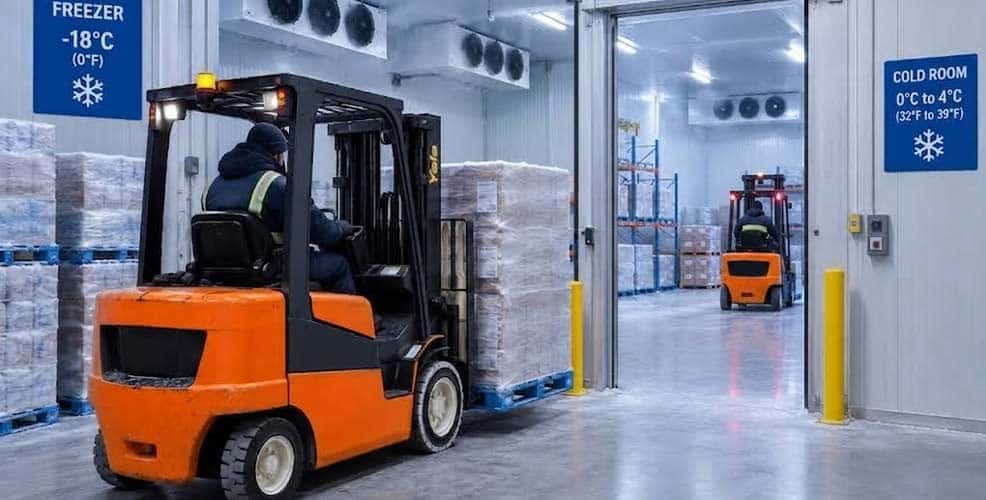
Cold storage forklift maintenance is crucial for safe, efficient, and reliable forklift operations in refrigerated warehouses and freezer environments. This type of maintenance usually involves four key areas: preventive maintenance, cold-weather component inspection, corrective maintenance, and maintenance planning based on the temperature zones where the equipment operates.
Preventive Maintenance for Cold Storage Forklifts
The following are the crucial preventive maintenance practices for cold storage forklifts. Let’s discuss further.
- Follow a maintenance schedule – Businesses need to follow a cold storage forklift maintenance schedule based on operating hours, equipment specifications, and the environmental conditions in which they are operating. Forklifts used in deep-freeze environments or continuously operated across multiple shifts may require more frequent inspections.
- Regular inspection of critical components – Businesses should regularly inspect batteries, electrical connections, hydraulic systems, brakes, tires, mast chains, and lifting mechanisms. These components may experience additional stress in cold conditions.
- Conduct pre-shift inspections – Regular pre-shift inspections can help identify visible damage, frost buildup, fluid leaks, battery warnings, and any unusual noises.
Cold-Weather Component Inspection
Cold-weather component inspection focuses on identifying the effects of low temperatures, moisture, and frost on the forklift’s major systems. Facilities need to inspect the following components regularly.
- Battery and electrical systems: Facilities should inspect battery terminals, connectors, wiring, and charging equipment for corrosion, moisture, loose connections, or visible damage. Additionally, they should check battery condition and ensure that the charging system is operating within the manufacturer’s specifications.
- Hydraulic systems: Facilities should examine hydraulic hoses, seals, fittings, and cylinders for leaks, stiffness, cracks, or signs of deterioration. Additionally, they should ensure smooth hydraulic system operation and consistent lifting and lowering operations.
- Lubrication points: Facilities should inspect mast chains, bearings, pivots, and other designated lubrication points for hardened grease, contamination, or inadequate lubrication.
- Tires and brakes: Facilities should check tire wear, pressure where applicable, and visible damage. Additionally, they should inspect the braking system for consistent operation and ensure that tires provide suitable traction for the warehouse floor conditions.
- Forks and lifting mechanisms: Facilities should examine forks for cracks, bending, and wear. Additionally, they should inspect mast chains, rollers, and lifting components for damage, abnormal movement, or frost buildup that may affect operation.
Corrective Maintenance and Troubleshooting
Corrective maintenance involves identifying and repairing issues that can affect forklift performance or safety. Common cold-storage forklift problems include:
- Reduced battery performance: A forklift may experience shorter operating times, reduced power, or battery warnings when operating in low temperatures.
- Sluggish hydraulic operation: Slow lifting, delayed mast movement, or unusual hydraulic noises may indicate that the hydraulic fluid is not suitable for the operating temperature or that the system requires inspection.
- Electrical faults: Intermittent controls, warning lights, sensor errors, or charging problems may be associated with moisture, corrosion, damaged wiring, or loose connections.
- Reduced traction or braking performance: Slippery floors, frost, tire wear, or brake-related faults may affect the forklift’s ability to stop and maneuver safely.
- Abnormal mast movement: Jerky lifting, unusual noises, or inconsistent lowering may indicate problems with the mast, chains, rollers, lubrication, or hydraulic system.
Maintenance Planning for Different Cold Storage Zones
Not all cold storage environments place the same demands on forklifts. Chill rooms, standard freezer rooms, and deep-freeze facilities operate at different temperatures. As a result, forklifts used in these environments may experience varying levels of moisture, frost, and thermal stress.
- Chill rooms: These environments generally operate at temperatures above freezing. Forklift maintenance should focus on battery performance, moisture exposure, lubrication, and the potential for condensation when equipment moves into warmer areas.
- Freezer rooms: Exposure to subzero temperatures can affect batteries, hydraulic systems, lubricants, seals, and tires. Therefore, forklift inspections should focus on cold-weather component performance, frost buildup, etc.
- Deep-freeze environments: Extremely low temperatures require forklifts specifically approved for those conditions. Maintenance planning should follow the manufacturer’s recommendations for batteries, hydraulic fluids, electrical components, lubrication, and temperature exposure.
- Transition zones and loading docks: Forklifts moving between cold rooms and warmer areas may be exposed to condensation, moisture accumulation, and repeated temperature changes. Therefore, maintenance plans should include procedures for inspecting forklifts after these transitions.
Cold Storage Forklift Maintenance Best Practices
The following are the cold storage forklift maintenance best practices that you should perform regularly in your facility. Let’s discuss further.
Cold storage forklift battery maintenance
Exposure to low temperatures can affect forklift battery performance. Hence, cold storage forklift battery maintenance is crucial to maintain overall forklift performance.
Lithium-ion battery maintenance
Lithium-ion batteries typically have battery management systems that monitor operating conditions and protect the battery from certain unsafe charging or discharging conditions. However, cold temperatures can affect their available power and charging capability. In this regard, cold storage forklift battery maintenance should include the following –
- Monitor battery temperature and any warnings displayed by the battery management system
- Follow the manufacturer’s minimum and maximum charging temperature limits
- Use approved chargers and battery heating systems
- Inspect connectors, cables, and battery enclosures for visible damage or moisture
- Avoid charging a cold battery outside its approved temperature range
- Monitor battery performance and investigate unusual changes in operating time or charging behavior.
Hydraulic System Maintenance
Essential hydraulic maintenance practices for cold storage forklifts include the following:
- Use cold-temperature-compatible hydraulic fluid – It is better to select only fluids approved by the forklift manufacturer for the operating temperature and hydraulic system specifications.
- Inspect hoses and seals – Check for cracks, stiffness, leaks, and deterioration that may be associated with cold exposure.
- Examine fittings and connections – Look for fluid seepage, loose fittings, or other signs of damage.
- Monitor hydraulic response – Pay attention to slow lifting, delayed lowering, jerky movements, or unusual noises.
- Follow appropriate warm-up procedures – Operate the hydraulic system according to the manufacturer’s instructions before demanding heavy lifting or intensive operation.
- Check fluid condition and levels – Maintain the recommended fluid level and follow the prescribed schedule for fluid replacement and filter servicing.
Lubrication of Moving Parts
The following are the crucial lubrication maintenance practices you should follow for cold storage forklifts.
- Choose low-temperature-compatible lubricants – Use only lubricants approved by the manufacturer for the forklift model and operating temperature.
- Lubricate designated components – Follow the maintenance manual for mast chains, bearings, pivots, joints, and other lubrication points.
- Inspect for hardened grease – Check whether existing grease has become stiff, contaminated, or unevenly distributed.
- Remove contamination appropriately – Clean lubrication points according to the manufacturer’s instructions before applying fresh lubricant.
- Maintain proper lubrication intervals – Follow the specified service schedule, adjusting it only when recommended for the actual operating conditions.
- Inspect moving components – Look for unusual resistance, squeaking, jerky movement, or visible wear that may indicate lubrication problems.
Tire, Brake, and Traction System Inspection
Tire inspection should include the following –
- Check tires for cracks, cuts, uneven wear, and other visible damage.
- Inspect tire pressure where applicable and maintain the manufacturer’s recommended pressure.
- Look for ice or frost buildup that could affect tire contact with the floor.
- Verify that the tire type is suitable for the forklift, load requirements, and floor conditions.
- Replace tires that have reached their service limits or show damage that affects safe operation.
Brake inspection should include the following –
- Check whether the brakes respond consistently during operation.
- Inspect brake components according to the manufacturer’s maintenance schedule.
- Report unusual noises, delayed braking, vibration, or changes in braking response.
- Ensure that moisture, ice, or contamination is not interfering with brake performance.
Traction and floor conditions –
- Inspect operating routes for water, ice, frost, and other slip hazards.
- Maintain clear travel paths and follow the facility’s procedures for managing slippery floors.
- Use forklifts and tires approved for the intended surface and operating conditions.
- Reduce speed and follow site-specific operating procedures when traction is limited.
- Any forklift with unreliable brakes or inadequate traction should be removed from service until the issue has been resolved.
Mast, Forks, and Lifting Mechanism Maintenance
Fork inspection should include the following –
- Inspect forks for cracks, bending, excessive wear, and other visible damage
- Avoid using forks that are bent, cracked, or excessively worn
Mast and chain inspection should include the following –
- Inspect mast chains for wear, corrosion, damage, and abnormal tension.
- Check mast rollers, guides, and other moving components for signs of wear or restricted movement.
- Verify that designated lubrication points are properly maintained.
- Look for frost or ice buildup that could interfere with the mast’s movement.
Lifting mechanism inspection should include the following –
- Test lifting, lowering, and tilting functions
- If the mast or lifting mechanism behaves abnormally, stop using the forklift and arrange an inspection by a qualified technician.
Electrical System and Sensor Inspection
Key electrical system maintenance practices for a cold storage forklift include:
- Inspect wiring and connectors – Check for damaged insulation, loose connections, corrosion, and signs of moisture.
- Check sensors and switches – Ensure that sensors, switches, and control inputs function correctly and are free from visible damage or frost-related obstruction.
- Inspect protective enclosures – Verify that electrical covers, seals, and enclosures are intact and properly secured.
- Test warning systems – Check lights, alarms, displays, and safety interlocks according to the prescribed inspection procedure.
- Use approved components – Confirm that replacement electrical components are suitable for the forklift model and its intended temperature range.
- Address faults promptly – Investigate intermittent electrical issues, warning messages, or unusual control behavior before returning the forklift to normal operation.
Therefore, by following all these cold storage forklift maintenance practices, you can ensure safe, effective, and reliable operations in your facility. If you are looking for the right cold storage forklift for your facility, get in touch with the Titan Forklifts team. They will help you select the right model based on your cold storage operational needs.