
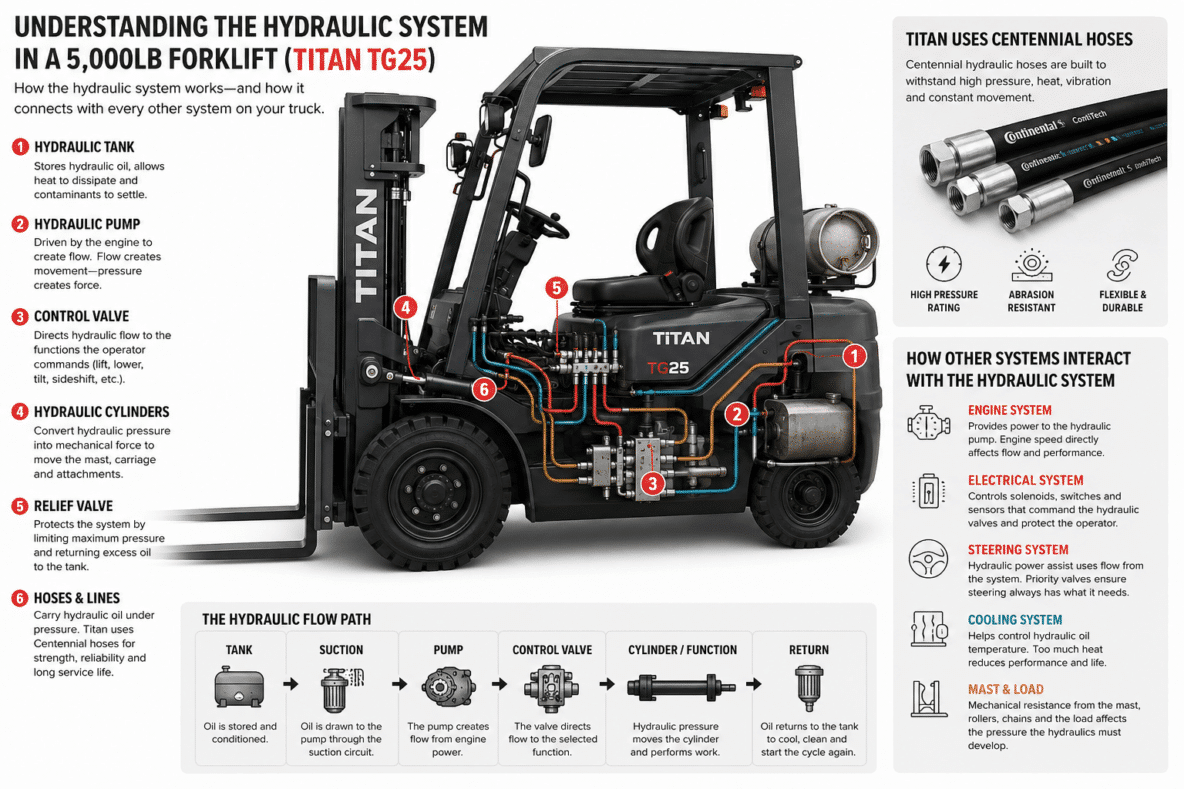
When a forklift operator pulls a hydraulic lever, the result may seem simple: the forks lift, the mast tilts, or an attachment moves. But behind that movement is a complex forklift hydraulic system. It involves working with the engine, hydraulic pump, control valves, cylinders, mast, electrical controls, steering system, and other components. For dealers and mechanics, understanding how these systems work together is essential for accurate forklift hydraulic troubleshooting.
How Does a Forklift Hydraulic System Work?
A forklift hydraulic system uses pressurized hydraulic oil to create the force needed for functions such as lifting, lowering, tilting, and operating hydraulic attachments.
A simplified hydraulic circuit can be represented as:
Hydraulic Tank → Suction Circuit → Hydraulic Pump → Control Valve → Hydraulic cylinder/Function → Return Circuit → Hydraulic Tank
Each component plays a specific role.
The reservoir stores hydraulic oil. The pump creates hydraulic flow. Control valves direct that flow to the appropriate function. Cylinders convert hydraulic energy into mechanical movement, while the return circuit sends oil back to the tank. The engine, electrical system, steering system, mast, and load all influence how effectively this process works. Understanding that relationship is the foundation of effective forklift hydraulic troubleshooting.
Pressure vs. Flow: The Basics of A Forklift Hydraulic System
Although they’re related, they aren’t the same thing. Flow creates movement, while pressure overcomes resistance. If a forklift has adequate hydraulic pressure but insufficient flow, the mast may lift a load but do so very slowly. On the other hand, if the forklift has adequate flow but cannot develop sufficient pressure, the mast may operate normally without a load but struggle when lifting a heavy pallet. Understanding the difference can help a technician narrow down the possible causes before replacing components.
Example: Forklift Lifts Empty but Won’t Lift a Load
Suppose a Titan TG25 comes into the shop with the complaint:
“The forklift lifts fine when empty, but it won’t lift a loaded pallet.”
The fact that the mast moves when empty indicates that the hydraulic system is producing some flow.
The next question is:
“Can the system develop the pressure required to lift the load?”
Potential areas to investigate include:
- Hydraulic pump condition
- Pressure relief valve
- Hydraulic control valve
- Internal cylinder leakage
- Other sources of pressure loss
Now consider a different complaint:
“The forklift lifts, but the mast is extremely slow.”
The technician should investigate flow-related issues, including:
- Pump speed
- Pump condition
- Engine RPM
- Hydraulic restrictions
- Oil condition
- Suction-side problems
- Filters and strainers
This is why understanding forklift hydraulic pressure and flow is so important when diagnosing performance issues.
Understanding the Major Components of a Forklift Hydraulic System
Following the path of the hydraulic oil is one of the easiest ways to understand the system. Let’s look at the major components and the hydraulic problems that can occur at each stage.
- Hydraulic Tank
The hydraulic reservoir is more than a storage container. It provides the hydraulic pump with a supply of oil while also helping the system:
- Release trapped air
- Dissipate heat
- Allow contaminants to settle
- Maintain a consistent oil supply
A low hydraulic oil level can quickly affect forklift performance. If the pump begins drawing air along with hydraulic oil, the system may become noisy, jerky, or inconsistent. Continued operation with inadequate oil can also contribute to pump damage. When investigating a hydraulic complaint, checking the hydraulic oil level and condition should be one of the first steps. Don’t overlook a basic problem while searching for a complicated one.
2. The Suction Circuit
The suction side connects the hydraulic reservoir to the pump. This part of the forklift hydraulic system is particularly important because the pump is designed to move hydraulic oil – not air. Restrictions or leaks on the suction side can contribute to cavitation or aeration. Common symptoms include:
- Hydraulic pump whining or growling
- Jerky hydraulic movement
- Foamy hydraulic oil
- Slow hydraulic operation
- Excessive heat
- Premature pump wear
Potential causes may include:
- Damaged suction hose
- Loose fittings
- Restricted strainer
- Incorrect hydraulic fluid
- Air entering the suction circuit
These problems can produce symptoms that look like a failing hydraulic pump. That’s why replacing the pump shouldn’t automatically be the first step in forklift hydraulic troubleshooting.
3. Hydraulic Pump
The hydraulic pump converts mechanical power into hydraulic energy by producing oil flow. On an internal-combustion forklift such as a typical LPG-powered 5,000-lb cushion truck, the engine provides the mechanical power needed to drive the hydraulic pump.
One important point for technicians to remember is that the pump creates flow, and pressure develops when that flow encounters resistance. When a forklift lifts a heavy load, resistance increases, and the hydraulic pressure rises accordingly. If the system cannot produce the required pressure, the forklift may struggle or fail to lift the load.
Further, if the engine isn’t reaching the required operating speed under hydraulic demand, the hydraulic pump may not turn fast enough. It may cause slow hydraulics. However, the underlying problem could be engine performance or engine-speed control. A hydraulic symptom doesn’t necessarily mean the hydraulic component is defective.
4. Hydraulic Hoses and Lines
Hydraulic hoses, tubes, fittings, and seals transport oil throughout the forklift hydraulic system. Titan Forklifts use Centennial hydraulic hoses for flexible hydraulic connections throughout the truck. Hydraulic hoses operate in demanding conditions and are exposed to the following.
- High hydraulic pressure
- Pressure spikes
- Heat
- Vibration
- Abrasion
- Bending
- Constant movement
- Temperature changes
A hose doesn’t have to burst completely to cause a problem. During forklift hydraulic maintenance, technicians should inspect hoses and connections for the following –
- Cracking
- Abrasion
- Damaged outer coverings
- Leaking crimps
- Loose fittings
- Twisting
- Excessive bending
- Rubbing against the frame or mast
- Oil around connections
Hose routing is particularly important around the mast. The hoses must move as the mast raises, lowers, and tilts without becoming stretched, pinched, twisted, or caught against moving components. A hose that looks normal when the mast is stationary may reveal a problem once the mast is fully raised or tilted.
5. Hydraulic Control Valve
The hydraulic control valve acts as the traffic controller for the system. The hydraulic pump supplies flow, while the control valve determines where that flow goes. Depending on the forklift configuration, different valve sections may control the following –
- Lift
- Lower
- Tilt forward
- Tilt back
- Side shift
- Fork positioning
- Hydraulic attachments
When the operator moves a hydraulic control, the valve spool changes position and creates a path for hydraulic oil. For example, when the operator selects LIFT, the lift control is activated, the control valve directs hydraulic oil toward the lift circuit, pressure develops as the system encounters resistance, the lift cylinder extends, and the mast and carriage rise.
When the operator selects TILT, hydraulic oil is directed to the appropriate side of the tilt-cylinder circuit.
Understanding this flow path helps technicians determine whether a problem is isolated to one hydraulic function or affects multiple functions.
6. Pressure Relief Valve
The pressure relief valve protects the forklift hydraulic system from excessive pressure. As a forklift attempts to lift a load, system resistance increases. If pressure continues rising beyond the designed limit, hydraulic components could be damaged. The relief valve provides a controlled pressure limit and operates according to its design when the specified pressure is reached.
A technician should never arbitrarily adjust the hydraulic relief valve to make a forklift lift more weight. Hydraulic pressure settings are part of the truck’s engineered system. Increasing the pressure setting does not increase the forklift’s rated capacity. Forklift capacity depends on the complete machine configuration, including:
- Stability
- Mast configuration
- Load center
- Attachment configuration
- Operating conditions
Always follow the manufacturer’s specifications and service information.
The Mast Can Cause Hydraulic Problems Too
The hydraulic cylinder provides lifting force, but the mast converts that force into controlled vertical movement. The mast assembly includes components such as:
- Lift cylinders
- Mast rails
- Rollers
- Chains
- Carriage
- Forks
- Bearings
- Wear surfaces
This means a hydraulic complaint may actually originate from a mechanical problem. For example, a forklift may have the following –
- Correct hydraulic pressure
- Adequate pump flow
- No obvious hydraulic leaks
Yet the mast may still move slowly or unevenly. A binding mast roller, damaged rail, improperly adjusted chain, or excessive mechanical resistance can increase the force required to move the carriage. The hydraulic system is then responding to that resistance. For accurate forklift hydraulic troubleshooting, technicians should evaluate both the hydraulic and mechanical sides of the lift system.
How Steering Can Help Diagnose Hydraulic Problems
Forklift steering commonly uses hydraulic power. Depending on the truck’s design, steering may have its own hydraulic supply or share flow through a priority circuit. A priority circuit ensures that steering receives the hydraulic flow it requires before less safety-critical functions. This can provide useful diagnostic information.
For example: Steering Works Normally but Lift Is Slow.
The technician can compare components shared by the steering and lift systems with components specific to the lift circuit.
Steering and Lift Are Both Slow
Now it makes sense to investigate components that may be common to both functions, including:
- Hydraulic oil level
- Pump drive
- Pump condition
- Suction circuit
- Hydraulic oil condition
- Engine speed
When multiple hydraulic functions show the same symptom, look for a common cause.
Electrical Problems Can Appear as Hydraulic Problems
Today’s forklifts often combine electrical controls with hydraulic functions. Depending on the truck and configuration, hydraulic operation can involve:
- Switches
- Sensors
- Solenoids
- Relays
- Controllers
- Safety interlocks
- Operator-presence systems
This means a hydraulic valve may be perfectly healthy but still fail to operate because the electrical command isn’t reaching it.
Example: Hydraulic Attachment Doesn’t Work
Suppose an auxiliary attachment suddenly stops working.
Instead of immediately checking hydraulic pressure, ask: Is the valve actually being commanded to operate?
A failed switch, damaged wire, poor connection, blown fuse, faulty solenoid, or safety interlock could prevent the hydraulic function from operating.
The symptom is hydraulic. The cause is electrical.
This is why effective forklift service requires technicians to understand how the truck’s electrical and hydraulic systems interact.
Hydraulic System Overheating
Some heat generation is normal in a hydraulic system. Excessive heat, however, can indicate a problem. Potential causes include –
- Excessive restriction
- Incorrect hydraulic oil
- Internal leakage
- Prolonged operation against relief pressure
- Poor cooling
- Contaminated oil
- Worn hydraulic pump
- Restricted return flow
As hydraulic oil temperature rises, its viscosity decreases. Lower viscosity can increase internal leakage and reduce hydraulic efficiency. Seals and other components may also experience additional thermal stress.
This can create a cycle:
Problem → Heat → Reduced Efficiency → More Heat
If a hydraulic complaint appears only after the forklift has been operating for some time, temperature should be part of the diagnostic process.
Common Forklift Hydraulic Problems and What to Check
The way a forklift behaves can provide valuable clues. The following guide can help technicians identify where to begin their investigation.
| Symptom | Areas Worth Investigating |
| Slow lift | Pump flow, engine RPM, suction restriction, oil condition |
| Lifts empty but struggles loaded | System pressure, pump condition, relief valve, internal leakage |
| Jerky mast | Air in system, low oil, suction leak, mast binding |
| Hydraulic pump whining | Cavitation, restriction, low oil, aeration |
| Hydraulic system overheating | Restrictions, internal leakage, relief operation, oil condition |
| Load slowly lowers | Cylinder seals, control valve leakage, external leakage |
| Tilt works but lift doesn’t | Lift valve section, lift circuit, cylinder/mast |
| Lift works, but attachment doesn’t | Auxiliary valve, electrical command, hoses, couplers, attachment |
| Steering and lift both slow | Pump supply, suction circuit, oil level, pump drive |
| Problem only occurs when hot | Oil viscosity, pump wear, internal leakage, overheating |
This guide isn’t a substitute for proper testing, but it can help determine where a technician should begin.
A Step-by-Step Approach to Forklift Hydraulic Troubleshooting
When dealing with a hydraulic complaint, avoid replacing components based solely on symptoms. Instead, work through the system systematically.
- Check the Hydraulic Oil – Confirm the oil level, condition, and specification. Look for signs of contamination or aeration.
- Inspect for Leaks – Check hoses, fittings, cylinders, valves, and connections.
- Inspect Hydraulic Hoses and Lines – Look for restrictions, abrasion, damaged hoses, poor routing, and loose connections.
- Listen to the Hydraulic Pump – Unusual whining, growling, or changes in pump noise can provide useful diagnostic clues.
- Inspect the Mast – Look for binding, damaged components, abnormal wear, or mechanical resistance.
- Check Engine Performance – Confirm that the engine is operating correctly and reaching the required speed when hydraulic functions are being used.
- Check Electrical Controls – Verify that relevant switches, sensors, solenoids, interlocks, and controllers are operating correctly.
- Perform Hydraulic Testing –When basic inspections don’t identify the problem, pressure and flow testing can provide more specific information.
Pressure Testing vs. Flow Testing
Pressure testing and flow testing answer different questions.
Hydraulic Pressure Testing
Pressure testing helps determine whether the system can reach the manufacturer’s specified operating pressure. It provides information about the system’s ability to develop the force required for a hydraulic function.
Hydraulic Flow Testing
Flow testing determines whether the pump is delivering the required volume of hydraulic oil. It provides information about the system’s ability to move at the required rate.
A forklift can have acceptable pressure but inadequate flow. It can also have adequate flow but fail to develop sufficient pressure.
That’s why both tests may be necessary when diagnosing a difficult forklift hydraulic problem.
Why Forklift Systems Should Be Diagnosed as a Whole?
One of the most important principles of forklift service is that the truck’s systems don’t operate independently.
Think of the relationship as:
Engine → Pump → Hydraulic Flow → Control Valve → Cylinder → Mast → Load
But several other systems influence this chain.
- Electrical controls determine whether certain hydraulic functions operate.
- The steering system may share hydraulic supply.
- The cooling system influences hydraulic temperature.
- The mast determines the mechanical resistance the hydraulic system must overcome.
- The load determines how much pressure the system needs.
A problem anywhere along this chain can change hydraulic performance. For dealers and technicians, looking at the forklift as one integrated machine can make diagnosis faster and more accurate.
Forklift Hydraulic System Maintenance
Good forklift hydraulic maintenance can help identify problems before they become expensive failures. Regular inspections should include:
- Hydraulic oil level and condition
- Hydraulic hoses and fittings
- Signs of external leakage
- Pump operation and unusual noise
- Hydraulic cylinders
- Mast components
- Hydraulic attachments
- Electrical controls associated with hydraulic functions
- Hydraulic system temperature and performance
Following the manufacturer’s recommended inspection and maintenance procedures is essential. Early detection can help reduce downtime, prevent secondary damage, and keep the forklift operating safely.
The Golden Rule for Forklift Hydraulic System Troubleshooting
When diagnosing a 5,000-lb. forklift such as the Titan TG25, don’t start by asking:
“Which hydraulic component is bad?”
Start with the symptom and work backward.
Ask the following:
- Is the pump receiving the correct mechanical power?
- Is the pump receiving clean, unrestricted oil?
- Is sufficient hydraulic flow being produced?
- Can the system develop the required pressure?
- Is the control valve directing flow correctly?
- Is the electrical system commanding the function?
- Can the cylinder hold pressure?
- Can the mast move freely?
- Is the load within the truck’s rated operating conditions?
These questions turn forklift hydraulic troubleshooting from guesswork into a structured diagnostic process. For dealers and mechanics, that can mean fewer unnecessary parts replacements, faster diagnosis, less downtime, and more efficient service.
Forklift Hydraulic Safety
Forklift hydraulic systems operate under significant pressure, and forklifts introduce additional hazards because of elevated components and loads.
Never work beneath an unsupported carriage, forks, or mast assembly.
Never use your hands to search for a pressurized hydraulic leak. High-pressure hydraulic fluid can penetrate the skin and cause serious injury.
Before opening a hydraulic circuit, technicians should follow the manufacturer’s service procedures for:
- Lowering and supporting equipment
- Shutting down the truck
- Relieving stored hydraulic pressure
- Isolating energy sources
- Performing hydraulic tests safely
Pressure settings, hydraulic specifications, fluid requirements, and test procedures should always be confirmed using the applicable Titan Forklifts service information for the specific truck and serial number.
Final Takeaway
A hydraulic complaint doesn’t always point directly to a hydraulic failure. The most effective technicians don’t simply replace the component that looks suspicious. They follow the system. For Titan Forklifts dealers and service professionals, that approach can lead to faster forklift hydraulic troubleshooting, fewer unnecessary repairs, reduced downtime, and more reliable equipment performance.