
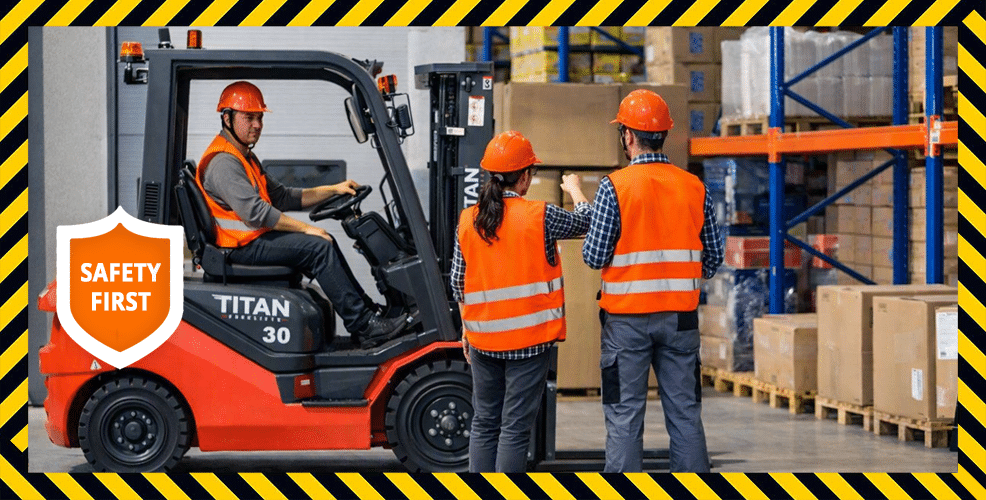
Forklifts play a crucial role in ensuring efficient material handling across various industries. They help in transporting, stacking, loading, and unloading materials. However, unsafe forklift operation can lead to serious workplace accidents. For instance, speeding, carrying an unstable load, not inspecting the forklift, etc., can create serious risks. Hence, forklift safety goes beyond operator training. Facilities should implement regular inspections, preventive maintenance, traffic-management procedures, safe load-handling practices, etc. Employers need to meet the applicable occupational health and safety requirements for creating a safe workplace.
Forklift Safety Regulations in Canada
Workplace safety responsibilities in Canada are divided between federal jurisdiction and provincial or territorial jurisdictions.
Canada’s Occupational Health and Safety Framework
Most Canadian workplaces fall under the occupational health and safety legislation of the province or territory where it operates. These regulations outline employer responsibilities for identifying hazards, providing training, and maintaining safe equipment and work procedures.
Some workplaces may fall under federal jurisdiction. These can include certain industries and operations that are federally regulated, such as interprovincial or international operations.
As a result, forklift safety requirements may differ depending on where and how a business operates. Therefore, employers should identify the legislation applicable to their workplace rather than relying on a generic national checklist.
Safety Requirements Can Vary by Industry
Forklift safety requirements will likely vary by industry. For instance, a forklift operating in a refrigerated warehouse may face different environmental challenges from one operating on a construction site. Similarly, a forklift used around flammable materials, heavy loads, narrow aisles, or outdoor terrain may require additional controls.
To ensure workplace safety, facilities need to combine regulatory requirements with a site-specific hazard assessment. Employers should identify the hazards associated with their facilities and accordingly implement safe forklift practices.
Employers should also follow the forklift manufacturer’s operating instructions, capacity information, maintenance recommendations, warning labels, and other safety information to ensure safe forklift operation.
Forklift Safety Requirements in Canadian Facilities
The following are the usual forklift safety requirements in Canadian facilities. However, based on individual facilities’ operational needs, additional safety rules might need to be followed. Let’s discuss further.
Operator Training and Certification
Authorized operators with appropriate training should operate forklifts. Operator training should combine both theoretical and practical knowledge. An operator needs to have a proper understanding of forklift operation and how factors such as load weight, load centre, turning, surface conditions, visibility, and mast position affect stability.
Training should address the specific forklift types and workplace conditions that the operator will likely encounter. For example, someone trained to operate a standard counterbalance forklift may require additional instruction before operating a different forklift model or working in a significantly different environment.
Employers should maintain appropriate records of training, evaluations, authorizations, and refresher instruction. Proper documentation indicates that the organization values operator competency and provides a record that training has been completed.
Daily and Pre-Operation Inspections
Another crucial aspect of ensuring forklift safety is daily and pre-operation inspections. It helps identify problems. Any defect that might make the forklift unsafe should be reported and addressed. Operators need to understand what they are checking, what constitutes an unsafe condition, and what action to take when a problem is discovered. In this regard, operators need to pay proper attention to the following components.
- Check that service and parking brakes function properly
- Check the steering for abnormal operation, excessive play, or difficulty controlling the forklift
- Check the tires and wheels for damage, excessive wear, or other defects
- Check forks and mast for cracks, deformation, excessive wear, and other damage
- Check hydraulic systems for leaks or other signs of malfunction
- Check the seat belts and restraint systems to ensure they function correctly
- Confirm the lights and warning devices are operating correctly
Load Capacity and Stability
A forklift should never be loaded beyond its manufacturer’s specified capacity. Operators also need to understand that factors such as the load centre, attachment being used, load height, and configuration of the equipment can affect its actual lifting capacity. Additionally, it is crucial to maintain safe loading practices.
Operators should avoid carrying loads that are unstable, excessively large, poorly secured, or positioned in a way that creates an unacceptable risk of tipping or falling.
Understanding the relationship between the load centre and forklift stability is crucial. As the load moves farther away from the forklift’s fulcrum, the risk of instability can increase. Operators should therefore follow the capacity information and instructions provided for the specific forklift and attachment.
Pedestrian and Traffic Controls
Forklift and pedestrian collision is one of the major hazards in busy industrial facilities. A person walking through a forklift travel path, particularly around blind corners, doorways, racks, or loading areas, is at a high risk of experiencing injury. In this regard, facilities can implement clearly marked pedestrian walkways, physical barriers, guardrails, warning signs, mirrors at blind intersections, etc., to separate pedestrian and forklift traffic.
Facilities should also establish workplace rules for speed, right-of-way, intersections, reversing, and pedestrian crossings. Extra caution is necessary in areas where visibility is restricted. Blind corners, narrow aisles, loading docks, warehouse entrances, and intersections should be assessed carefully to determine whether additional administrative controls are necessary.
Final Thoughts
An effective forklift safety program combines regulatory compliance, operator competency, equipment inspections, preventive maintenance, workplace traffic controls, safe load handling, pedestrian protection, and consistent supervision. Titan Forklifts provides forklifts to facilities in Canada and North America. Whether a facility follows a Canadian regulatory framework or an OSHA-based U.S. framework, facilities need to ensure proper forklift safety. Forklift safety is a shared responsibility. Employers are responsible for providing appropriate equipment, training, procedures, maintenance, and workplace controls. On the other hand, operators need to follow safe operating practices to reduce the risk of injuries and property damage. It further helps reduce downtime, equipment repair costs, and operational disruption.