
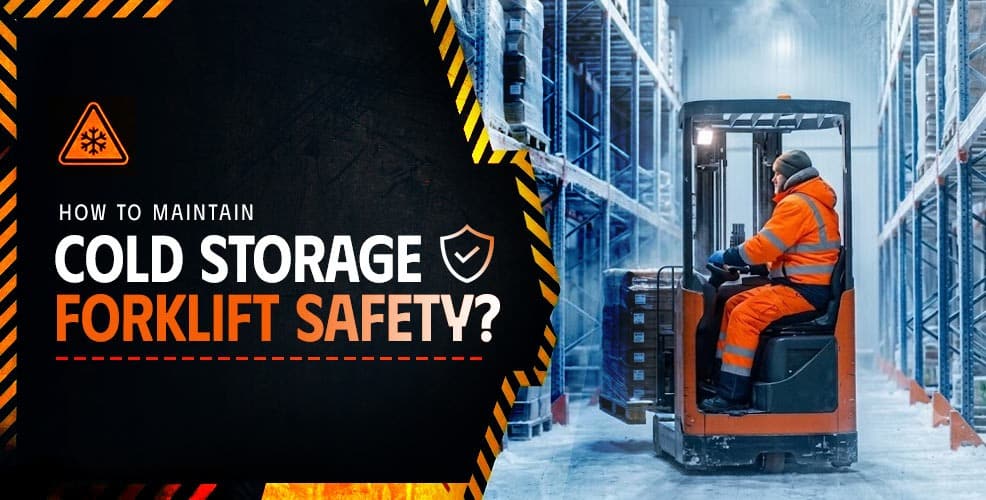
Operating forklifts in cold storage facilities is challenging compared to standard warehouses. Low temperatures, slippery floors, condensation, and limited visibility, and frequent temperature changes can affect forklift performance and operator safety. Identifying these hazards and addressing them is crucial to reduce accidents and maintain cold storage forklift safety.
Common Hazards in Cold Storage Facilities
The following are common hazards in cold storage facilities that businesses should be aware of. Taking appropriate precautions and preventive measures is crucial to maintain cold storage forklift safety. Let’s discuss further.
Slippery floors and reduced traction
Condensation, ice, frost, and water can build up on cold storage floors. It can create slippery surfaces that reduce tire traction. It can be hazardous near freezer doors, loading areas, refrigeration units, and transition zones where temperatures fluctuate. Reduced tire traction increases braking distances and makes steering more difficult. A forklift can also become less stable when turning, accelerating, or carrying a heavy load on a slippery surface.
Poor Visibility
Visibility is a major challenge in cold storage facilities. Frost and condensation can accumulate on windows, mirrors, cameras, and other surfaces. On the other hand, fogging can occur when forklifts move between areas with different temperatures. Low lighting, tall racks, and loads that block the operator’s view can add more blind spots.
Extreme Cold and Temperature Changes
Forklifts in cold storage facilities can face extremely low temperatures for long periods. Frequent transitions between refrigerated areas and warmer spaces can cause condensation on electrical components, controls, windows, and other surfaces. Facilities should follow manufacturer recommendations for operating and storing forklifts in cold storage facilities.
Battery Performance and Charging Hazards
Low temperatures can affect battery performance, especially for electric forklifts. Cold conditions can reduce available battery capacity and operating time. It may cause them to require more frequent charging or battery changes. Cold-storage facilities should use batteries and charging systems appropriate for the forklift and its environment.
Load Stability and Falling Loads
Handling products in cold storage adds extra load-handling challenges. Frozen products may be packaged differently, wet surfaces can affect pallet stability, and temperature-sensitive goods may require specialized handling or storage procedures.
PPE for Cold Storage Forklift Operators
Personal protective equipment (PPE) is crucial to maintain cold storage forklift safety. The specific PPE required should be based on the facility’s hazards, temperature, forklift, and workplace requirements.
- Insulated Cold-Weather Clothing – Operators working in cold storage facilities may need insulated clothing or other protective layers. Layered clothing can help operators adjust to changing conditions when moving between freezer and ambient-temperature areas.
- Cold-Resistant Gloves – Cold-resistant gloves can help protect operators’ hands from low temperatures. They will also allow operators to maintain adequate grip and control.
- Safety Footwear – Insulated safety footwear can help protect operators from cold floors and low temperatures while preventing workplace hazards. Footwear should also provide suitable slip resistance for wet, icy, or refrigerated surfaces.
- Head, Face, and Eye Protection – Depending on the facility, operators may need head, eye, face, or other protective equipment. Safety glasses or other suitable eye protection can help protect against debris and other workplace hazards.
Cold Storage Forklift Safety Best Practices
The following practices can help maintain cold storage forklift safety. Let’s discuss further.
Choose the Right Forklift for The Environment
Facilities should consider the operating temperature, expected duty cycle, floor conditions, storage layout, load requirements, and manufacturer’s specifications when selecting a cold storage forklift. Additionally, they should consider forklift power source, battery type, tires, hydraulic system, attachments, corrosion resistance, operator protection, visibility features, and temperature limitations.
Perform Pre-shift Forklift Inspections
Pre-shift forklift inspections are crucial to maintain cold storage forklift safety. Operators should check items such as:
- Tires and traction
- Brakes and steering
- Forks, mast, chains, and load-handling components
- Hydraulic systems
- Battery and connections
- Lights, mirrors, cameras, and warning devices
- Seat belts and operator restraints
- Controls and safety systems
- Signs of leaks, damage, frost, or excessive moisture
Drive at a Safe Speed
Speed control is crucial when operating on slippery or wet surfaces. Operators should reduce speed around corners, intersections, freezer doors, loading areas, ramps, and congested sections of the facility. Sudden acceleration, braking, or steering can reduce stability and increase the likelihood of losing traction or shifting a load. Operators should maintain a speed that allows them to remain in control and stop safely under the existing conditions.
Maintain a Safe Following Distance
Cold storage floors may require greater stopping distances when traction is reduced. Operators should maintain sufficient space between forklifts. They should also maintain additional distance near intersections, pedestrian crossings, loading areas, doors, and other locations where unexpected stops may occur.
Keep Loads Stable and Within Capacity
Forklifts should always be operated within their rated capacity. Operators should know the weight and dimensions of the load and understand how load position and attachments can affect the forklift’s capacity and stability. They should center the loads properly on the forks and keep them as low as practical while traveling. Operators should avoid carrying loads that block their view and should use an appropriate travel method when visibility is restricted.
Use forklift Attachments Correctly
Forklift attachments can improve material-handling efficiency, but they can also change the forklift’s capacity, load center, visibility, and stability. Hence, it is crucial to use the right forklift attachments for the specific forklift.
Follow Designated Travel Routes
Facilities should establish clear travel routes for forklifts and pedestrians. Where possible, physical barriers or other controls should separate the two traffic streams. Operators should remain within designated forklift lanes and follow posted traffic rules. Horns and other warning devices should be used appropriately at intersections, blind corners, doorways, and other areas where visibility is restricted.
Control Entry and Exit Between Temperature Zones
Moving forklifts between freezer rooms and warmer areas can result in condensation and moisture buildup. This can affect visibility, traction, electrical components, and other equipment systems. Facilities should establish procedures for moving equipment between temperature zones and allow appropriate inspection or moisture-control measures where recommended by the manufacturer. Operators should pay particular attention to windows, mirrors, cameras, floors, and controls after significant temperature changes.
Maintain Proper Lighting and Visibility
Good visibility is essential when operating forklifts in high-density cold storage facilities. Hence, it is crucial to use lights, mirrors, cameras, warning systems, and other visibility aids. Besides, facilities should address concerns like frost, ice, condensation, dirt, and damaged components. Facility lighting should also be sufficient for aisles, intersections, loading areas, and other high-traffic locations. Therefore, by following all these practices, you can reduce the risk of accidents in freezer environments and maintain cold storage forklift safety. The Titan Forklifts team can provide you with the right cold storage forklift based on your facility’s needs and guide you on ways to maintain workplace safety.