
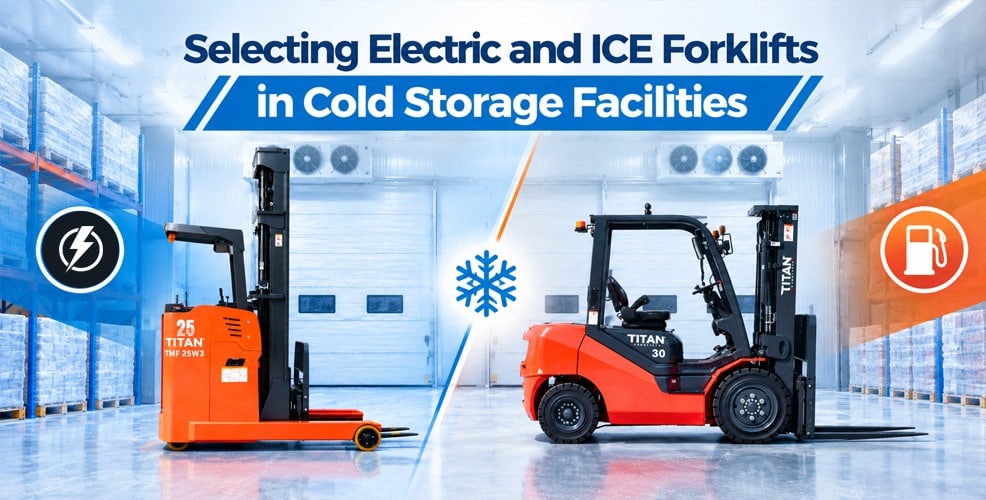
Cold temperatures can affect overall forklift performance. Freezing temperatures can slow down forklifts, drain batteries faster, and make everyday tasks more challenging. When it comes to selecting the right forklift for cold storage facilities, the two main options are electric forklifts and ICE (internal combustion engine) forklifts. The latter includes diesel and LPG/propane models. Electric forklifts are usually the go-to choice for indoor cold storage. They don’t produce tailpipe emissions, run quietly, and help keep indoor air clean. Hence, they are ideal for food warehouses and pharmaceutical storage. ICE forklifts, on the other hand, are better suited for heavy-duty work, outdoor use, or situations where quick refueling matters more than emissions. Selecting the right forklift between electric and ICE forklifts in cold storage depends on the operating cycle, load requirements, ventilation, and available infrastructure.
Pros and Cons of Electric Forklifts in Cold Storage
When selecting between electric and ICE forklifts in cold storage facilities, let’s discuss the benefits and disadvantages of electric forklifts. Electric forklifts are used in refrigerated and freezer environments. These forklifts and batteries are properly specified for low-temperature operation. However, cold temperatures can cause some challenges, which you need to address before choosing an electric fleet.
Benefits of electric forklifts in cold storage units
The following are the benefits of electric forklifts in cold storage facilities. Let’s discuss further.
- Zero tailpipe emissions – Electric forklifts don’t produce exhaust. Hence, they are ideal for indoor use. This helps maintain better air quality and removes the need to manage engine fumes in tight, enclosed spaces.
- Quiet operation – They’re much quieter than ICE forklifts. As a result, they allow easy communication and create a less stressful work environment, especially when multiple forklifts are running at once.
- Lower routine maintenance – With fewer moving parts and no engine oil, spark plugs, or fuel filters to worry about, electric forklifts generally need less routine maintenance. That said, you still need to inspect batteries, tires, brakes, and hydraulics regularly.
- Better for clean, air-sensitive facilities – In food distribution, grocery, and pharmaceutical warehouses, air quality and cleanliness matter. Electric forklifts fit naturally into these environments because they don’t release exhaust indoors.
- Can handle freezer work – When properly configured, electric forklifts perform well even in deep-freeze conditions. The key is to ensure that the forklift, battery, tires, hydraulics, and electronics are all rated for the temperatures they’ll operate in.
Disadvantages of electric forklifts in cold storage units
Electric forklifts can have the following disadvantages. Let’s discuss further.
- Battery performance drops in extreme cold – If a forklift isn’t designed for low temperatures, its battery won’t deliver full power in a freezer. That means less runtime and more frequent charging.
- Shorter runtimes – The amount of runtime you lose depends on battery type, temperature, load weight, travel distance, and how often you’re lifting. A forklift that spends most of its shift in a deep freezer needs more careful energy planning than one that only operates occasionally.
- Charging gets trickier – Charging in very cold conditions isn’t as simple as plugging in. You need to think about where batteries are charged, how warm that area is, and what the manufacturer recommends for low-temperature charging.
- Battery size must match your workflow – When selecting a battery, you need to consider how many hours it runs, how much time is spent in the freezer, how heavy the loads are, and whether there are chances to recharge between shifts.
- Condensation can cause problems – When a cold forklift moves into a warmer area, moisture can form on components. Repeated trips between freezer and ambient zones increase this risk, so equipment design and maintenance become even more important.
A standard electric forklift isn’t automatically suitable for prolonged freezer work. Components may need special protection or cold-rated designs. Always check the manufacturer’s temperature ratings and recommendations.
In this regard, Titan Forklifts offers specialized forklift and battery combinations that can operate in facilities with temperatures as low as -40°. You can get in touch with our team to select the right forklift model for your cold storage units.
Can You Use a Diesel Forklift in Cold Storage?
Diesel forklifts might be used in some cold-storage applications, but they are generally not the preferred choice for enclosed or freezer warehouse environments.
- Diesel engines produce exhaust, so ventilation becomes a major issue indoors
- Very cold temperatures make starting harder and increase the need for proper maintenance and starting systems
- Fuel and lubricants behave differently in the cold, so you need the right fluids and procedures
- Hydraulic fluid thickens in low temperatures, which can affect lifting and travel until the system warms up
- Cold, wet, or icy floors reduce traction, making tire choice and regular inspections critical
- Moving between very different temperatures can cause condensation, which may damage components over time
In short, diesel forklifts are better suited to outdoor yards or well-ventilated loading docks than to enclosed freezers.
Can You Use an LPG/Propane Forklift in Cold Storage?
LPG (propane) forklifts are a middle ground. They’re often used in refrigerated warehouses and loading docks, especially when a forklift needs to move between indoor and outdoor areas. They offer quick refueling and are common in operations that run continuously.
However, LPG forklifts still produce combustion emissions, so ventilation and indoor air quality remain important. They shouldn’t be treated as equivalent to electric forklifts just because they use propane instead of diesel.
Propane can be more practical than diesel in some indoor applications, but suitability depends on your facility’s ventilation, temperature, and workplace safety requirements. For enclosed freezer operations where minimizing emissions is a priority, electric forklifts are usually the better fit.
Comparing Electric and ICE Forklifts for Cold Storage Facilities
| Factor | Electric Forklift | ICE Forklift |
| Tailpipe emissions | None | Yes |
| Indoor use | Well suited | Requires appropriate ventilation |
| Freezer operation | Possible with proper configuration | Possible, but application-dependent |
| Noise | Generally lower | Generally higher |
| Cold-weather considerations | Battery performance and charging | Engine, fuel, lubrication, and starting |
| Energy/refueling | Requires charging infrastructure | Fast refueling |
| Routine maintenance | Generally lower | Generally higher |
| Narrow-aisle operation | Often well suited | Depends on model |
| Heavy-duty applications | Model-dependent | Often advantageous |
| Operator environment | Quieter, no tailpipe exhaust | More noise and exhaust emissions |
| Best fit | Indoor/refrigerated warehousing | Outdoor, heavy-duty, mixed applications |
Things to consider when choosing electric forklifts for cold storage
Choosing an electric forklift for a freezer warehouse requires more than simply selecting an electric model. The battery, forklift configuration, operating cycle, charging strategy, and environmental conditions all need to work together.
Battery Type Matters
Battery choice is one of the biggest decisions. Both lead-acid and lithium-ion batteries can be used, but they behave differently in the cold:
- Lead-acid batteries lose a lot of capacity as temperatures drop. They may need longer charging times and more careful charging practices, especially if the forklift runs for long periods in low temperatures.
- Lithium-ion batteries offer advantages like opportunity charging, steadier power delivery, and less routine maintenance. Cold still affects them, but they generally handle low temperatures better than lead-acid. Charging a cold lithium-ion battery may still require temperature management or manufacturer-approved systems.
Hence, Titan Forklifts thoroughly test their cold storage forklift and battery systems in extreme cold. By matching the truck, battery, hydraulic fluids, lubricants, electronics, and other components to the operating environment, we offer a complete forklift solution.
Freezer-Ready Forklift
A forklift meant to operate in a freezer often needs special components and protection, such as:
- Cold-resistant electrical components rated for your temperature range
- Hydraulic fluids and lubricants that stay effective in the cold
- Protection against condensation and moisture from temperature changes
- Tires that grip well on cold, wet, or slippery surfaces
- Operator heating and comfort features for people working in low temperatures
- Low-temperature-rated parts designed for long-term freezer operation
Operating Cycle
How you use the forklift can affect performance just as much as the temperature itself. You should consider the following factors.
- How often it moves between freezer and ambient areas. Frequent transitions increase condensation risk and can affect battery and component life.
- How much time it spends inside the freezer. A forklift that’s in a deep freezer most of an eight-hour shift has very different needs than one that only goes in for a few minutes at a time.
- Travel and lifting intensity, as frequent acceleration, long distances, heavy loads, and repeated lifting all use more energy.
- Available charging opportunities to allow seamless forklift charging without disrupting productivity.
- Continuous or intermittent operation, as the former requires larger battery capacity or additional batteries/forklifts, while the latter allows more charging opportunities.
Comparing the use of electric and ICE forklifts in cold storage units, it can be stated that in indoor cold storage operations, electric forklifts are a preferred choice. At Titan Forklifts, we offer specialized forklifts for cold storage facilities that can perform well even at -40°C. Let our team assess your operational needs, and we can recommend the ideal forklift solution for your cold storage facility.