
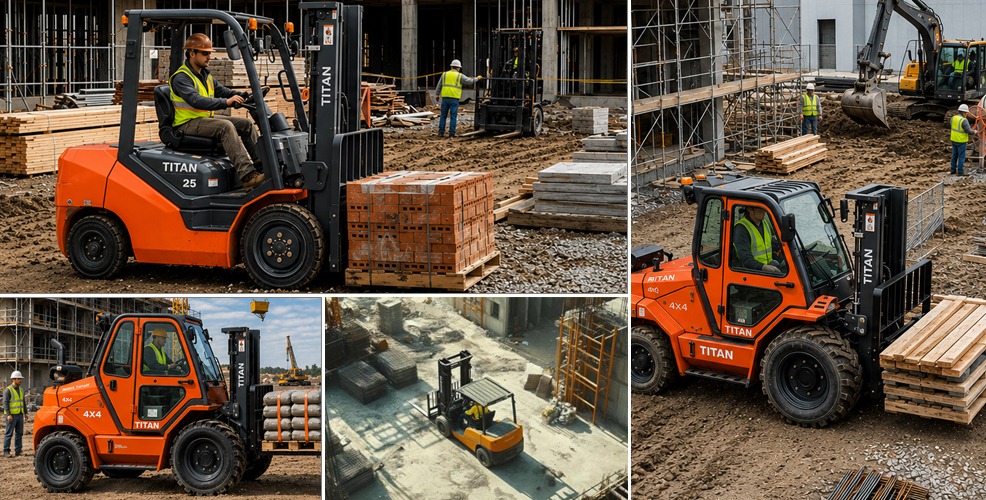
Construction sites involve various working environments. Based on their varying operational needs, the ideal forklift type will also vary. For instance, forklifts well-suited for transporting pallets of bricks might not be suited for transporting landscaping or HVAC materials. Selecting the right forklift for each construction trade helps improve productivity, reduce downtime, and enhance operator safety.
Selecting the Right Forklifts for Each Construction Trade
Construction trades can be of different types. Let’s further discuss the right type of forklifts for each construction trade.
General Contractors
They oversee various construction activities. Hence, they require forklifts that can perform multiple material handling tasks throughout different project phases. From unloading building materials and transporting pallets to moving equipment around the jobsite, these forklifts need to be versatile to meet various operational needs.
Medium- to heavy-capacity forklifts with pneumatic tires can operate on both paved and rough construction surfaces. Hence, these forklifts are best suited for these types of construction trades. Ideal forklift features should include the following.
- Heavy-duty forklifts
- Durable pneumatic or solid pneumatic tires
- High ground clearance
- Excellent visibility for crowded job sites
- LED lighting for early morning or evening operations
Masonry and Bricklaying
These contractors frequently move heavy pallets of bricks, concrete blocks, pavers, mortar bags, and stone materials. To carry these dense loads, they need forklifts with strong lifting capacity and better stability.
For unfinished construction sites where gravel, mud, or uneven ground make material transportation challenging, rough-terrain forklifts will be best suited. Other ideal forklift types for this type of construction trade can be –
- Diesel forklifts for outdoor projects
- Electric forklifts for indoor masonry work
Steel Erection
These types of projects involve transporting materials such as steel beams, columns, and other heavy structural components. As these materials often have uneven weight distribution, they require forklifts with heavy-duty lifting capability and excellent stability.
High-capacity forklifts equipped with long forks and reinforced masts can help safely transport structural steel across construction sites. Additionally, operators should secure loads properly, avoid sudden movements, maintain safe travel speeds, and ensure adequate visibility throughout lifting operations. When selecting a forklift for this type of construction trade, you need to consider the following features –
- High lifting capacities appropriate for steel loads
- Heavy-duty mast construction
- Extended forks for long materials
- Enhanced counterweight design
- Excellent hydraulic performance for smooth lifting
Roofing Contractors
They regularly transport shingles, insulation panels, roofing membranes, plywood, and other building materials. Therefore, they need forklifts with sufficient lift height that can maneuver effectively around active construction zones. Ideal forklift types for this construction trade are rough-terrain forklifts. Other features you should consider when selecting the right forklift are –
- Adequate lift height for multi-story buildings
- Stable operation with elevated loads
- Strong hydraulic systems for smooth load placement
Plumbing Contractors
They handle long pipes, plumbing fixtures, water heaters, pumps, tanks, and mechanical equipment throughout commercial and residential construction projects. For partially completed buildings with hallways, narrow entrances, and unfinished interiors, forklifts with higher maneuverability are best suited. Other features you should consider are –
- Compact turning radius
- Smooth hydraulic controls
- Excellent visibility
- Moderate lifting capacity suitable for plumbing equipment
Electrical Contractors
They frequently move cable reels, conduit bundles, electrical panels, transformers, generators, switchgear, and delicate electrical equipment. Electric forklifts are well suited for indoor electrical work. They can operate quietly, produce zero exhaust emissions, and offer excellent maneuverability inside completed or partially completed buildings. Other forklift features you should consider for this type of construction trade are –
- Compact chassis
- Tight turning radius
- Precise lifting controls
- Excellent visibility
- Low operating noise
- Ability to transport oversized cable reels and heavy electrical equipment without compromising stability
HVAC Contractors
This type of construction work involves transporting large duct sections, rooftop units, furnaces, condensers, air handlers, and ventilation equipment. To lift such bulky components, HVAC contractors need to use forklifts with sufficient lifting capacity while maintaining stability. Other forklift features you should consider are –
- Stable mast design
- Smooth hydraulic controls
- Wide fork spacing
- Side shifters for precise positioning
- Excellent load visibility
Concrete Contractors
They often need to transport cement bags, reinforcing materials, concrete forms, precast wall panels, pipes, barriers, and heavy construction supplies. These demanding applications require forklifts built for durability and consistent heavy lifting. Diesel-powered rough-terrain forklifts are ideal, and they can operate effectively on muddy, gravel-covered, or uneven job sites. Other forklift features you should consider are –
- Heavy-duty lifting capability
- Rugged chassis construction
- Powerful hydraulic systems
- Pneumatic tires with aggressive tread
- High ground clearance
Landscaping Contractors
They need to transport pavers, retaining wall blocks, decorative stone, mulch, soil, trees, shrubs, irrigation supplies, and outdoor construction materials across diverse terrain. All-terrain forklifts provide excellent traction and stability when operating on grass, dirt, gravel, or soft ground. Other features you should consider are –
- High flotation tires
- Moderate lifting capacity
- Excellent maneuverability
- Durable weather-resistant construction
Demolition Contractors
These projects involve transporting debris containers, reclaimed construction materials, structural components, scrap metal, and heavy waste while working around unstable structures. They require forklifts that are durable, with reinforced frames, protective overhead guards, puncture-resistant tires, and components designed to withstand harsh working conditions. Other forklift features you should consider are –
- Heavy-duty construction
- Reinforced operator protection
- Excellent stability
- High-capacity lifting capability
- Durable pneumatic or solid tires
Different construction trades have varied material handling needs. Hence, they require forklifts suitable for meeting individual construction-specific operational needs. Titan Forklifts presents various forklift models that can meet operational needs for each construction trade. Our team can assess your requirements to help you match with the right forklift type.