
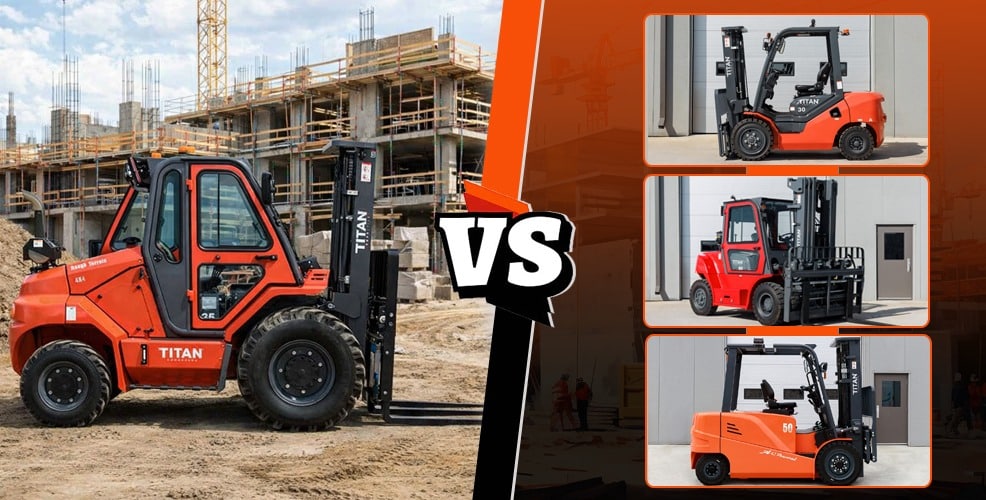
Construction sites involve varied terrain. Hence, choosing the right forklift is critical to improve productivity and maintain workplace safety. Whether you are transporting pallets of bricks, steel beams, lumber, or construction supplies, the right forklift can help minimize downtime, reduce operating costs, and improve efficiency. Both rough terrain forklifts and all-terrain forklifts are commonly used in the challenging environments of construction sites. However, each has its own strengths. Understanding the differences between these forklifts allows businesses to select the right option to meet their specific construction needs.
Comparison between Rough Terrain and All-Terrain Forklifts
The following highlights the key differences between rough terrain and all-terrain forklifts. Let’s discuss further.
Performance on varied terrain
Rough terrain forklifts have powerful four-wheel drive systems, high ground clearance, and aggressive tires. It allowed them to easily navigate muddy, loose gravel, soft sand, and uneven rocky terrain while maintaining traction. On the other hand, all-terrain forklifts perform well on moderately rough ground along with paved roads, concrete slabs, and warehouse yards. Hence, they are ideal for both outdoor construction sites and finished surfaces.
Stability on uneven ground
When lifting heavy loads on unpredictable terrain, forklifts must maintain stability. Rough terrain forklifts have wider wheelbases, reinforced frames, and low centers of gravity. It helps improve forklift balance when operating on slopes or uneven ground. Their robust suspension systems help reduce the risk of tip-overs even when carrying heavy materials. On the other hand, all–terrain forklifts offer good stability. However, they might not be suitable for extreme off-road conditions. As a result, compared to rough terrain forklifts, they may not provide the same level of stability on severely uneven terrain.
Tire design
Rough terrain forklifts use large pneumatic tires with deep, aggressive tread patterns. It helps improve traction in mud, loose soil, gravel, and other challenging environments. Besides, their tires can withstand sharp rocks, debris, and harsh job site conditions. All-terrain forklifts also utilize pneumatic tires. However, their tread patterns allow operators to move comfortably between construction sites and finished work areas. They offer reliable grip across multiple surface types. However, they may wear faster due to constant operation in extremely rugged terrain.
Lifting capacity
Construction sites involve the movement of heavy materials. Rough terrain forklifts usually have higher lifting capacities. It makes them ideal for moving concrete blocks, steel beams, timber bundles, large pallets, etc. Besides, heavy-duty hydraulic systems allow rough-terrain forklifts to support heavy lifting in challenging working environments. On the other hand, all-terrain forklifts are preferred for their flexibility. Their lifting capacity is adequate to handle general construction material.
Maneuverability
Construction sites involve navigating around equipment, materials, and partially completed structures. All-terrain forklifts generally feature tighter turning radii. It allows them to maneuver more easily in confined spaces. On the other hand, rough terrain forklifts prioritize stability and lifting power over compact maneuverability. These forklifts can navigate open construction sites effectively. However, they may need more space to complete turns.
Travel speed
Construction projects often require transporting materials across large work areas. All-terrain forklifts can offer higher travel speeds on both paved and unpaved surfaces. It allows operators to move materials efficiently between different work zones, such as construction zones, storage areas, finished surfaces, etc. On the other hand, rough terrain forklifts focus more on controlled movement and traction than travel speed.
Selecting Rough Terrain and All-Terrain Forklifts Based on Types of Construction Sites
Different types of construction sites have different needs. Therefore, selecting the right forklift model for the right operational needs is crucial to boost productivity and efficiency.
Large commercial construction projects
These sites require continuous lifting of heavy structural materials, steel beams, concrete blocks, and even large equipment. Besides, these sites often involve undeveloped terrain with mud, gravel, slopes, and uneven ground. In such conditions, rough terrain forklifts are ideal due to their superior lifting capacity, traction, and stability.
Residential construction sites
Residential projects involve transporting lighter building materials such as lumber, roofing supplies, drywall, and palletized products. Besides, they involve narrow driveways, smaller lots, etc. In such conditions, all-terrain forklifts are best suited as they have adequate lifting capacity and offer easier maneuverability.
Road and infrastructure projects
These projects require transporting materials across extensive job sites that may span several kilometers. Road construction often includes gravel, dirt, unfinished pavement, and constantly changing terrain. In such conditions, rough terrain forklifts usually perform better due to their exceptional off-road capabilities and heavy-duty design.
Mixed-surface construction sites
Many construction projects involve working across concrete slabs, asphalt roads, gravel lots, and unfinished terrain throughout the day. In such conditions, all-terrain forklifts might be best suited.
Things to consider when selecting rough terrain and all-terrain forklifts
Now that you know the difference between rough-terrain and all-terrain forklifts, let’s discuss what to consider when selecting the right forklift for construction sites.
Type of terrain
We have discussed earlier how rough terrain and all-terrain forklifts are suitable for different types of construction sites. Therefore, you need to assess the terrain conditions to select appropriate forklift models. For instance, rough terrain forklifts are ideal for terrain consisting of mud, sand, gravel, or rocky ground. On the other hand, all-terrain forklifts are suited for sites involving concrete and asphalt alongside uneven terrain.
Load capacity requirements
You should also consider the types of materials to be transported and the maximum lift height needed at the construction sites. For instance, if the sites involve transporting heavy structural components, then you need to select forklifts with higher lifting capacity and stability.
Frequency of use
Businesses using forklifts daily for demanding operations may benefit from investing in specialized rough terrain forklifts. On the other hand, contractors with occasional or varied usage might benefit from all-terrain forklifts.
Site accessibility
You should assess available operating space, access roads, overhead clearance, and obstacles. For instance, tight spaces require compact equipment with superior maneuverability, while open sites can accommodate larger machines. Therefore, to put it simply, rough terrain forklifts are ideal for construction sites that involve heavy-duty lifting in challenging outdoor environments. On the other hand, all-terrain forklifts are ideal for both paved and unpaved surfaces. Hence, they are used on sites that involve frequent movement of materials between warehouses, construction sites, and finished project areas. Titan Forklifts offers both rough terrain and all-terrain forklifts to improve productivity and workplace safety in construction sites. Get in touch with our authorized dealers to select the right forklift models based on your construction needs.